Monday, June 24, 1861
In the early months of the Civil War, a Union naval mission to gather intelligence on Virginia’s Northern Neck turned into a deadly skirmish with Confederate volunteers. Discover how a routine operation aboard the USS Monticello quickly escalated into a fierce clash that left both sides scrambling.
Narrative
The Action at Carter’s Creek was fought on Monday, June 24, 1861 between Union forces commanded by Lt. Daniel L. Braine and Confederate forces commanded by Capt. Isaac Currell in present-day Lancaster County, Virginia. The brief exchange of fire resulted in a Confederate victory when the Union landing party was driven off with two casualties.
On April 27, in response to the capture of Harpers Ferry Arsenal and Gosport Navy Yard, U.S. President Abraham Lincoln extended the naval blockade of seven original Confederate States to include the ports of Virginia. Flag-Officer Silas H. Stringham’s Atlantic Blockading Squadron, which included the screw-steamer USS Star (Monticello), patrolled the Chesapeake Bay, boarding and searching ships and engaging with Confederate shore batteries at Gloucester Point, Sewell’s Point, and Pig Point. In late May, the Monticello was damaged during the Engagement at Sewell’s Point and was sent back to Washington, D.C. for repairs.
Meanwhile, Confederate volunteers quickly formed companies in Virginia’s Tidewater region, erecting forts and batteries at strategic points along the coastal waterways. Companies from Virginia’s Northern Neck—a peninsula between the Potomac and Rappahannock Rivers—formed the 40th Virginia Infantry Regiment, commanded by Col. John M. Brockenbrough. Since a regiment typically consisted of only 10 companies, some units were left waiting for assignment. One such unit was Currell’s Company from Lancaster County, commanded by Capt. Isaac Currell.
On June 13, the Monticello returned to Fort Monroe under the command of Lt. Daniel L. Braine. Ten days later, on June 23, Flag-Officer Garrett J. Pendergrast ordered Lt. Braine to intercept a blockade runner near Smith Island. While sailing up the Chesapeake, the Monticello‘s pilot informed Braine of a steamer called the Virginia that could be captured near the mouth of the Rappahannock River. Braine decided to take a brief detour on June 24, but the Virginia was nowhere to be found.
The Monticello‘s pilot then mentioned that a man named James W. Gresham, who lived near the mouth of Carter’s Creek on the Northern Neck, might have useful information. A landing party of 18 armed men, led by Master’s Mate Lewis A. Brown and Assistant Surgeon Heber Smith, went ashore in the steamer’s launch—a small craft armed with two swivel guns and a rowboat. While speaking with Gresham, about 30 men from Currell’s Company, led by Adjutant Henry S. Hathaway, opened fire from behind bushes and trees along the shore.
Brown later reported, “I heard a man on the stoop say that there was a company of well-drilled volunteers in the vicinity, and on my turning about I saw a company of armed and uniformed men stealing along the shore as if to cut off our retreat. I immediately ordered a retreat to the boat and fired off our carbines, many of which missed fire…”
The Union landing party immediately ran for their launch, leaving the rowboat behind. While wading through the shallow water, Assistant Surgeon Heber Smith and Quartermaster August Peterson were wounded (Peterson later died at Fort Monroe). The launch crew returned fire with their carbines and swivel guns.
Once the landing party was safely back aboard the Monticello, Lt. Braine ordered his gunners to fire on Gresham’s house, called Pop Castle, causing severe damage. There were no reported Confederate casualties, and the Monticello returned to Fort Monroe empty-handed.
Opposing Forces
Confederate
Lt. Col. Charles A. Crump, Commanding
| Unit | Commander(s) | Strength | Killed | Wounded | Captured |
|---|---|---|---|---|---|
| Currell’s Company | Capt. Isaac Currell Adj. Henry S. Hathaway | 30 | 0 | 0 | 0 |
Union
Lt. Daniel L. Braine, Commanding
| Unit | Commander(s) | Strength | Killed | Wounded | Captured |
|---|---|---|---|---|---|
| USS Monticello / Star | Lt. Daniel L. Braine | 96 men, 3 guns | 1 | 1 | 0 |
Timeline
May 22, 1861: Currell’s Company of Lancaster County volunteers enlists in the Virginia militia for one year.
June 5, 1861: The converted revenue cutter USS Harriet Lane exchanges fire with Confederate shore batteries at Pig Point at the mouth of the James River.
June 10, 1861: Union Brig. Gen. Benjamin F. Butler orders a disastrous attack on Confederate Col. John B. Magruder’s forces on the Virginia Peninsula at Big Bethel.
June 23, 1861: USS Monticello / Star leaves Hampton Roads and steams up the Chesapeake toward Tangier and Smith Islands.
Location
GPS Coordinates — 37.64083, -76.42558
Primary Sources
News Articles
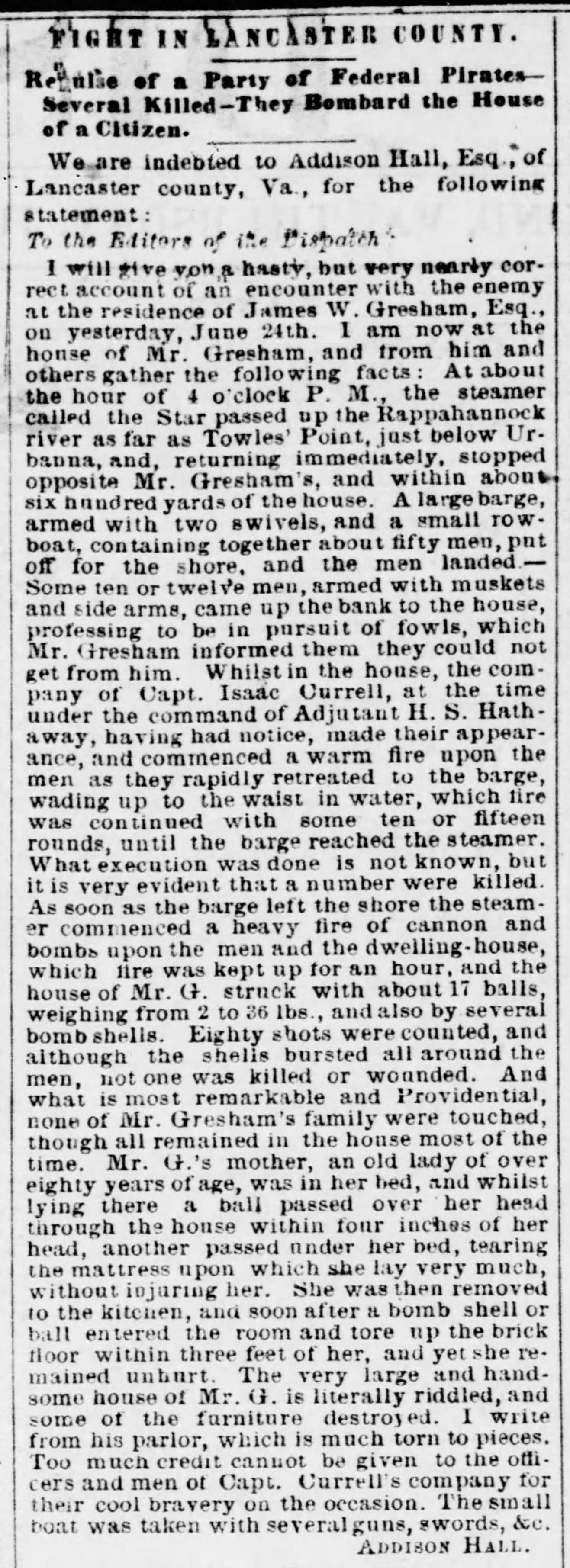
Richmond Dispatch (Richmond, VA) 27 June 1861.
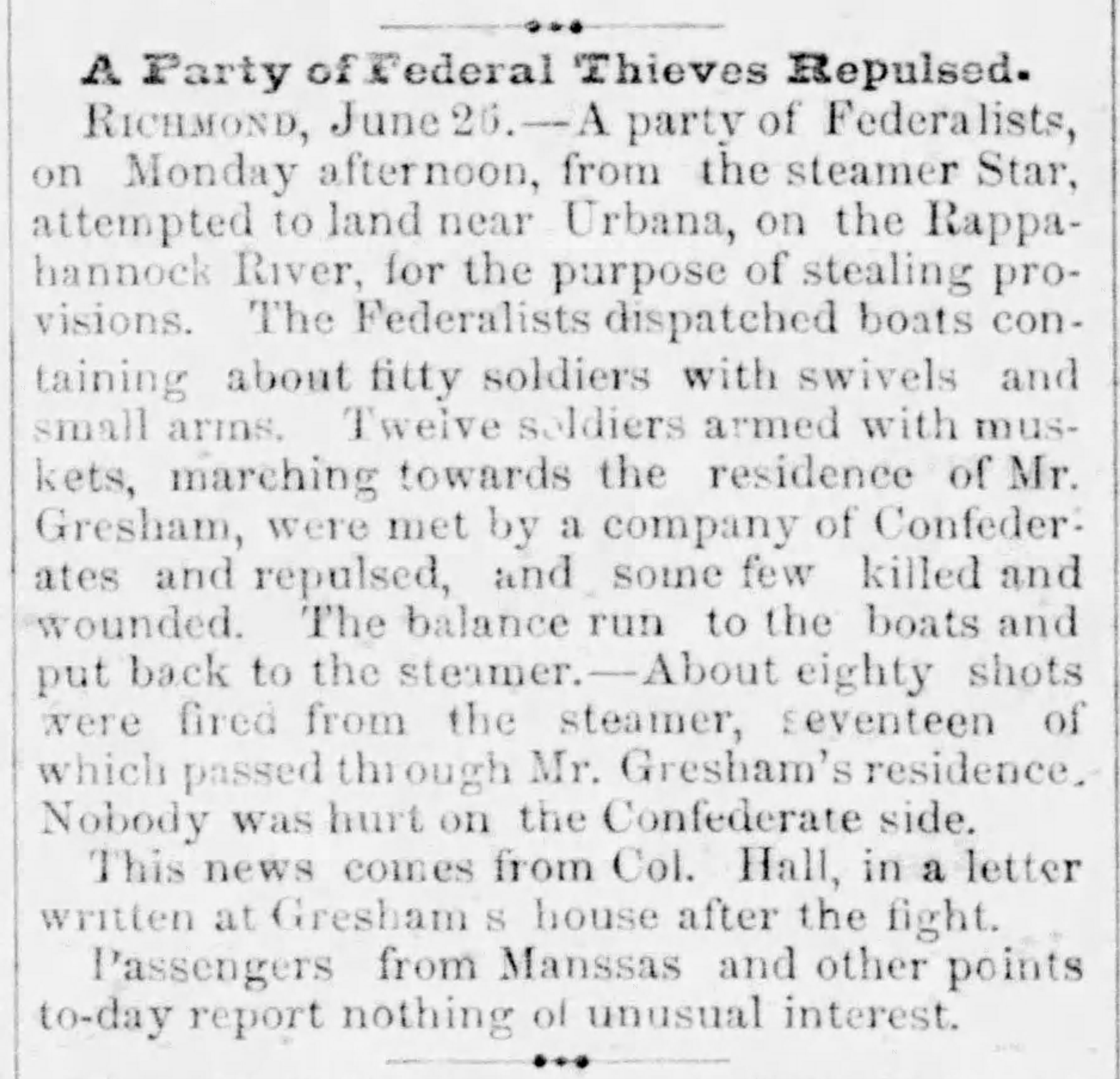
The Macon Telegraph (Macon, GA) 28 June 1861.
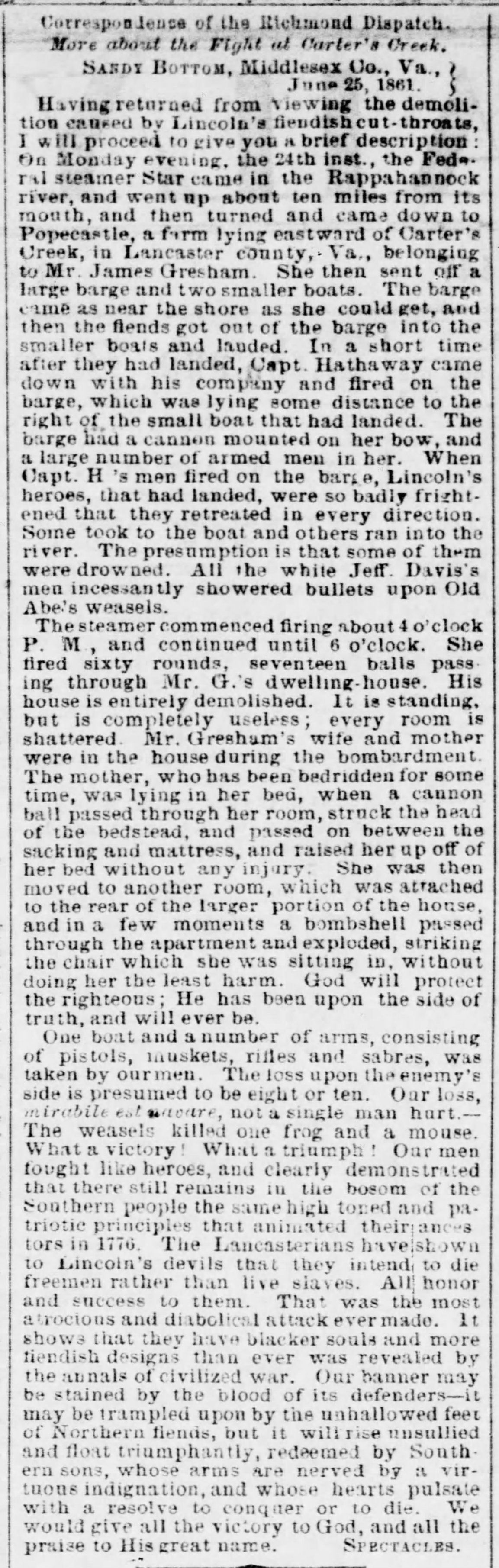
Richmond Dispatch (Richmond, VA) 28 June 1861.
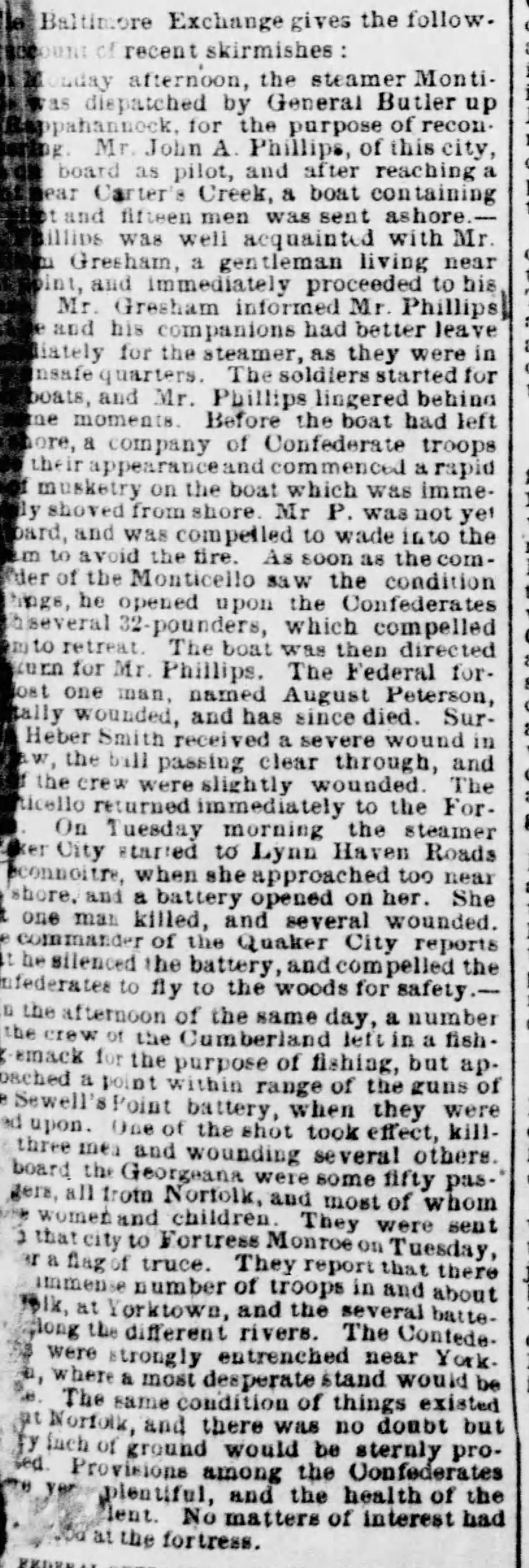
Richmond Dispatch (Richmond, VA) 29 June 1861.
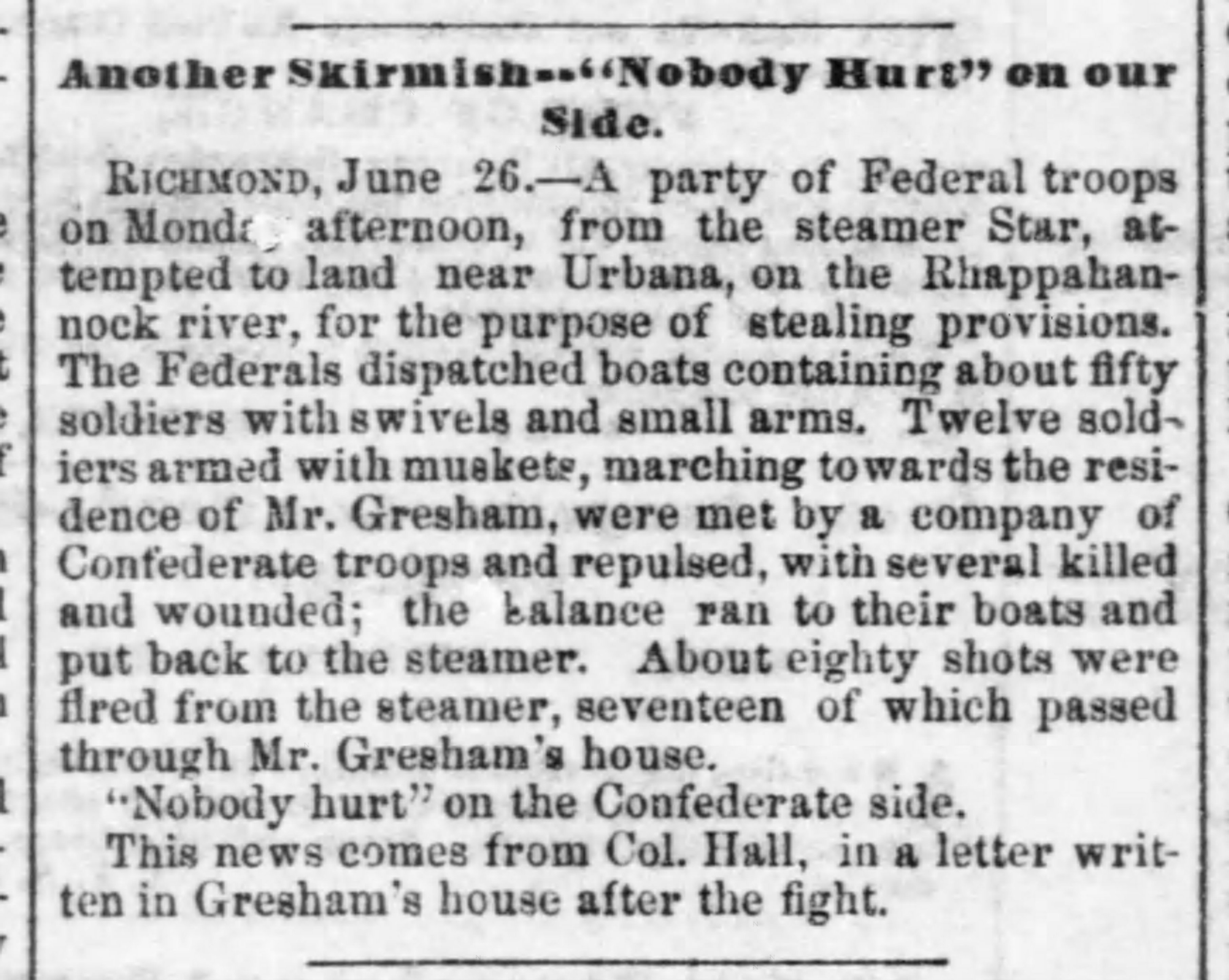
Nashville Union and American (Nashville, TN) 29 June 1861.
Reports and Letters
- June 23 Order of Flag-Officer Pendergrast, U. S. Navy
- June 24 Report of Lieutenant Braine, U. S. Navy
- June 24 Report of Master’s Mate Lewis A. Brown, U. S. Navy
- June 25 Account of George W. Havemeyer, Acting Captain’s Clerk
- June 26 Report of Lieutenant Braine, U. S. Navy
- June 26 Report of Flag-Officer Stringham, U. S. Navy
- June 27 Letter from Brigadier-General Magruder, C. S. Army
- June 30 Report of Flag-Officer Stringham, U. S. Navy
Secondary Sources
Wallace, Lee A., Jr. A guide to Virginia Military Organizations, 1861-1865. Lynchburg: H.E. Howard, Inc., 1986.
Updated: 6 March 2025
Created: 25 September 2024
 Spirit of '61