Wednesday, July 17, 1861
In mid-July 1861, Union Brig. Gen. Jacob D. Cox’s attempt to drive Confederate forces from West Virginia’s Kanawha Valley met stiff resistance at the Battle of Scary Creek. Despite initial gains, Union troops were ultimately repelled by a determined Confederate defense, leading to significant casualties and delaying further Union advances in the region.
Narrative
The Battle of Scary Creek was fought on Wednesday, July 17, 1861 between Union forces commanded by Brig. Gen. Jacob D. Cox and Confederate forces commanded by Brig. Gen. Henry A. Wise in Putnam County, West Virginia. It resulted in a Confederate victory, but ultimately had no affect on the overall campaign. Union forces captured Charleston a week later after Confederates withdrew from the Kanawha Valley.
In early July 1861, 34-year-old Maj. Gen. George Brinton McClellan (1826-1885), head of the U.S. Military Department of the Ohio, aimed to expel former Virginia governor Henry A. Wise and his “Wise Legion” from the Kanawha River Valley. Wise had established a base camp near Charleston with roughly 2,700 Confederate troops, conducting several reconnaissance missions in the surrounding area. He arrested Virginia unionists and posed a threat to McClellan’s ongoing operations farther north.
To confront Wise, McClellan turned to Brig. Gen. Jacob Dolson Cox, Jr. (1828-1900), who commanded a force of about 3,000 men, including the 1st and 2nd Kentucky (U.S.) and the 11th, 12th, and 21st Ohio Infantry regiments, along with two cannons and a small cavalry unit. Cox divided his troops into three columns, ordering them to converge at Red House before advancing on Charleston.
On July 13, the 2nd Kentucky engaged and scattered a small Confederate force at Barboursville. Later that afternoon, Cox arrived at Red House—about 31 miles upriver from his starting point at Point Pleasant—with four companies of the 11th Ohio, as well as the 12th and 21st Ohio regiments and four cannons (two without caissons or cannoneers).
Meanwhile, Brig. Gen. Henry A. Wise sent Lt. Col. George S. Patton with approximately 900 men to Camp Tompkins at the mouth of the Coal River. Patton, however, determined that the bluffs overlooking Scary Creek, three miles down river, would make a much better defensive position. He moved the Kanawha Riflemen, Putnam Border Rifles, Bailey’s Company, and Hale’s Kanawha Battery into place above Scary.
On July 14, Col. Jesse S. Norton led Companies F, G, and H of the 21st Ohio on a reconnaissance mission along the Kanawha River’s south bank, reaching the mouth of Scary Creek. Confederate artillery fired warning shots, prompting Norton’s men to retreat. That evening, when half of the 1st Kentucky (U.S.), under Lt. Col. David Alexander Enyart, arrived at Red House, Cox sent them along with the remaining 21st Ohio troops to reinforce Norton. However, in the ensuing darkness, a misinterpreted order led to a friendly-fire incident, resulting in three deaths and several injuries.
Over the next two days, Cox consolidated his position near the mouth of the Pocatalico River, a tributary of the Kanawha. On July 16, the 11th Ohio briefly skirmished with Confederate cavalry. The following morning, Cox dispatched Lt. Col. Carr B. White of the 12th Ohio on a reconnaissance toward Scary Creek. White’s men exchanged fire with Capt. Andrew R. Barbee’s Putnam County Border Rifles before withdrawing to report their findings.
Cox authorized Col. John Lowe of the 12th Ohio to lead his regiment, along with Cotter’s Independent Battery and George’s Independent Company of Ohio cavalry, to dislodge the Confederates from Scary Creek. At the last moment, he added Col. Norton and two companies of the 21st Ohio, given Norton’s familiarity with the area. After the battle, Cox faced criticism for not allowing Norton to bring his entire regiment.
Simultaneously, Lt. Col. Patton received news that Union troops had returned to Scary Creek. Patton gathered two cavalry companies and the Kanawha Artillery to reinforce the three infantry companies already stationed at Scary Creek. En route, local women presented Capt. Albert G. Jenkins’ Kanawha Border Rangers with a flag. Patton’s reinforcements arrived just in time.
Lowe’s Union forces approached Scary Creek along two roads that merged below the Simms House. The battle began around 2 p.m. with an artillery duel between Cotter’s Battery and the Kanawha Artillery. Union rifled guns, known for their accuracy, destroyed one Confederate cannon, killing Lt. James C. Welch. To preserve his remaining artillery, Patton ordered it to cease firing.
Confederate Capt. James W. Sweeney’s small infantry company from Wheeling, (West) Virginia occupied a cluster of buildings across the burnt bridge on the north bank of Scary Creek, firing on Union troops through the windows. After George’s cavalry made an ineffectual attempt to dislodge them, Col. Norton personally led an infantry attack supported by a devastating barrage from Cotter’s Battery. Sweeney’s men fled, but as they did, Cotter’s Battery ran out of ammunition.
The Union forces devised a plan for Lt. Col. White to lead a bayonet charge with two companies of the 21st Ohio, while Maj. Jonathan D. Hines and a detachment from the 12th Ohio attempted a flanking maneuver by crossing Scary Creek upstream. However, Hines’ detachment became tangled in dense underbrush, and those who managed to cross the creek failed to join the main attack.
White succeeded at the bridge, driving the Confederates back and wounding Lt. Col. Patton severely. Command then fell to Capt. Albert Jenkins, who rallied his troops. Reinforcements soon arrived, including the Sandy Rangers, Kanawha County militia, and an additional cannon, tipping the scales back in the Confederates’ favor. Col. Norton was wounded and captured, and the Confederates reclaimed the bridge.
Exhausted and short on ammunition, Col. Lowe ordered a retreat, covered by the remaining troops of the 21st Ohio, whom Cox had belatedly ordered forward. Misinterpreting the withdrawal, Jenkins briefly pulled his men back, leaving the battlefield temporarily deserted. When the Confederates realized their mistake, they returned and set nearby buildings ablaze to prevent their use by Union forces.
It was after sundown. Observing the smoke from the fires, Col. Charles A. De Villiers of the 11th Ohio and several officers of the 2nd Kentucky—Col. William E. Woodruff, Lt. Col. George W. Neff, Capt. George Austin, and Capt. John R. Hurd—mistakenly assumed that Lowe had won. They crossed the river to greet who they thought were their fellow compatriots, only to be captured by Jenkins’ Confederates and sent to Libby Prison in Richmond.
The defeat at Scary Creek stunned Cox’s command. Seven officers, including three colonels, were captured, with 15 men killed and over 35 wounded and 11 captured or missing. The loss, combined with a shortage of supply wagons, delayed further Union advances by nearly a week. Confederate casualties included four dead, twelve wounded, and four captured. Wise tried to follow up on the victory, but discretion was the better part of valor. He ultimately chose to withdraw from Charleston on July 24, retreating to Gauley Bridge to avoid being cut off by advancing Union forces to the north, who had recently captured Cheat Mountain.
Opposing Forces
Confederate
Brig. Gen. Henry A. Wise, Commanding
| Unit | Commander(s) | Strength | Killed | Wounded | Captured |
|---|---|---|---|---|---|
| 1st Kanawha Regiment, 5 Companies | Lt. Col. George S. Patton, Sr. | 375* | 1 | 7 | 2 |
| 2nd Kanawha Regiment, 4 Companies | Capt. Albert G. Jenkins | 300* | 2 | 5 | 1 |
| Wise Legion Cavalry | Lt. Col. Francis P. “Frank” Anderson | 150 | 0 | 0 | 0 |
| 2nd Regiment, Wise Legion, 1 Company | Capt. Robert G. Crank | 59 | 1 | 1 | 0 |
| Kanawha Militia | Capt. B. S. Thompson | 40* | 0 | 0 | 0 |
| 924 | 4 | 13 | 3 |
Union
Brig. Gen. Jacob D. Cox, Commanding
| Unit | Commander(s) | Strength | Killed | Wounded | Captured |
|---|---|---|---|---|---|
| 21st OH Infantry Regiment, Companies D & K | Col. Jesse S. Norton | 178 | 4 | 4 | 1 |
| 12th OH Infantry Regiment | Col. John Lowe | 1,000 | 8 | 33 | 1 |
| Cotter’s Ind. Battery Ohio Light Artillery | Capt. Charles S. Cotter | 2 guns, 24 men | 1 | 0 | 0 |
| George’s Ind. Company Ohio Cavalry | Capt. John S. George | 40 | 1 | 0 | 0 |
| 1,250 | 14 | 37 | 11* |
Timeline
July 11, 1861: Union Brig. Gen. Jacob D. Cox, Jr. crosses the Ohio River with five regiments to drive Brig. Gen. Henry A. Wise’s brigade out of the Kanawha Valley.
July 13, 1861: Lt. Col. George W. Neff and five companies of the 2nd Kentucky (U.S.) defeat Confederate forces at Barboursville, (West) Virginia. Cox arrives at Red House.
July 14, 1861: Col. Jesse S. Norton of the 21st Ohio leads a reconnaissance mission along the Kanawha River’s south bank to Scary Creek, but retreats after being fired on by Confederate artillery.
July 16, 1861: Cox establishes a camp at the Pocatalico River. Confederate cavalry skirmish with his advanced units.
July 17, 1861: Cox sends Col. John Lowe of the 12th Ohio, two companies from the 21st Ohio, Cotter’s Independent Battery, and George’s Independent Company of Ohio cavalry, to dislodge the Confederates from Scary Creek.
Location
GPS Coordinates — 38.43562, -81.8544
Primary Sources
News Articles
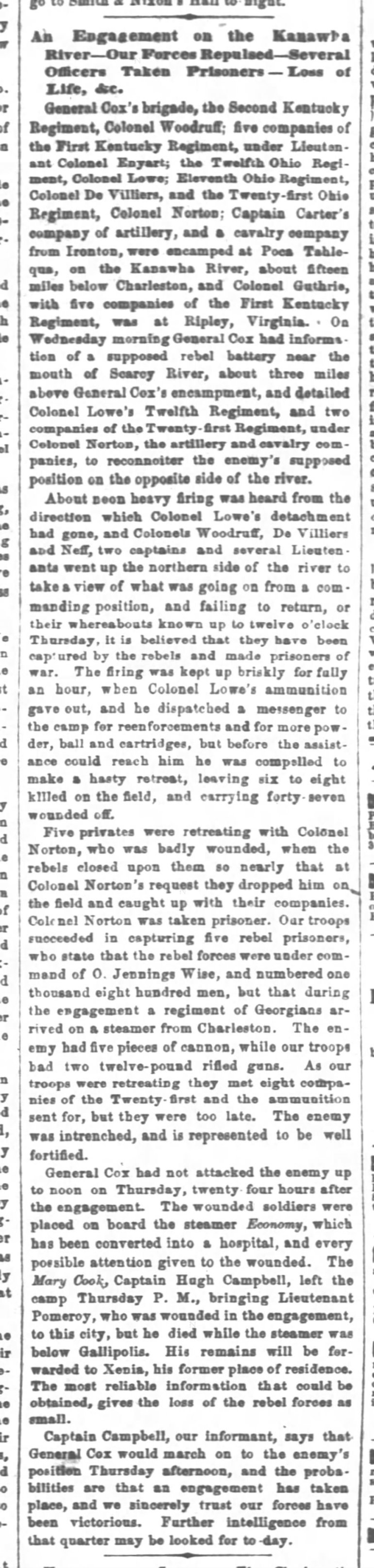
Cincinnati Enquirer (Cincinnati, OH) 20 July 1861.

The Clermont Courier (Batavia, OH) 24 July 1861.
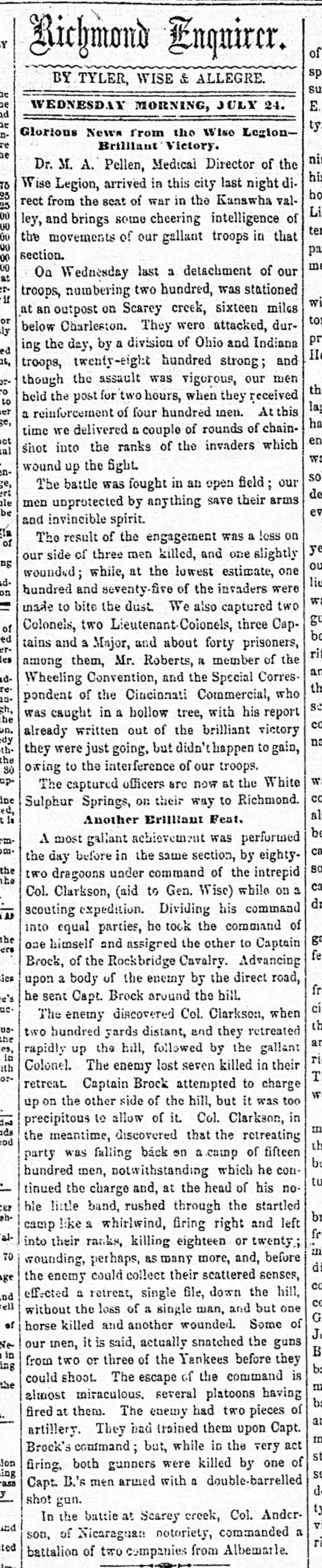
Richmond Enquirer (Richmond, VA) 26 July 1861.
Reports and Letters
- Jul. 2 Instructions to Brig. Gen. Jacob D. Cox
- July 11 Report of Jacob D. Cox, District of the Kanawha
- Jul. 14 Report of Maj. Gen. George B. McClellan (2nd)
- July 14 Report of Jacob D. Cox, District of the Kanawha
- July 16 Report of Jacob D. Cox, District of the Kanawha
- July 17 Report of Brig. Gen. Henry A. Wise, C.S. Army
- July 18 Report of Brig. Gen. Henry A. Wise, C.S. Army
- Jul. 19 Report of Major-General George B. McClellan of Action at Scarey Creek
- July 19 Report of Brig. Gen. Henry A. Wise, C.S. Army
Memoirs
Cox, Jacob Dolson. Military Reminiscences of the Civil War. Vol. I. New York: Charles Scribner’s Sons, 1900.
Sedinger, James D. “War-Time Reminiscences of James D. Sedinger Company E, 8th Virginia Cavalry (Border Rangers).” West Virginia History 51 (1992): 55-78.
Sources
Dickinson, Jack L. 8th Virginia Cavalry. Lynchburg: H.E. Howard, Inc., 1986.
Horton, Joshua H. A History of the Eleventh Regiment (Ohio volunteer infantry). Dayton: W.J. Shuey, 1866.
Lowry, Terry D. 22nd Virginia Infantry. Lynchburg: H.E. Howard, Inc., 1998.
Lowry, Terry. The Battle of Scary Creek: Military Operations in the Kanawha Valley April – July 1861. Charleston: Quarrier Press, 1982, 1998.
Moore, Robert H. Graham’s Petersburg, Jackson’s Kanawha, and Lurty’s Roanoke Horse Artillery. Lynchburg: H.E. Howard, Inc., 1996.
Phillips, David L. War Diaries: The 1861 Kanawha Valley Campaigns. Leesburg: Gauley Mount Press, 1990.
Ward, James E.D. Twelfth Ohio Volunteer Inf. Ripley: By the author, 1864.
Updated: 15 March 2025
Created: 18 March 2021
 Spirit of '61