Friday, June 21, 1861
In June 1861, a Union detachment led by Capt. David F. Cable clashed with pro-Confederate militia at a fortified house in Northwest Virginia. The nighttime skirmish, which resulted in casualties on both sides and the burning of the Righter home, was emblematic of the deep divisions that defined the Civil War in western Virginia.
Narrative
The Action at Righter’s House (aka Coon Run) was fought on Friday, June 21, 1861 between Union forces commanded by Capt. David F. Cable and Virginia cavalry commanded by Capt. John Righter in Marion County, West Virginia.
Following their rout at Philippi on June 3, Virginia’s secessionist volunteers retreated to Huttonsville, astride the Staunton-Parkersburg Turnpike in Randolph County. On June 6 in Richmond, Virginia Governor John Letcher signed General Orders No. 25, transferring control of Virginia’s Provisional Army and Navy to the Confederate government. Newly arrived Confederate President Jefferson Davis promoted Robert E. Lee’s adjutant, Robert Selden Garnett, to brigadier general and assigned him command of the army in the northwest.
Forty-one-year-old Robert S. Garnett was a former U.S. Army officer and assistant instructor of infantry tactics at West Point who withdrew into his military career after the deaths of his wife and daughter. He caught up with Col. George Porterfield and the remnants of his small army in Huttonville on June 14, where he wrote to Lee: “I found there twenty-three companies of infantry… in a most miserable condition as to arms, clothing, equipment, instruction, and discipline.”
Garnett knew his prospects for repelling Maj. Gen. George B. McClellan’s invasion were slim, but he recognized the importance of blocking the two main turnpikes that crossed the Alleghenies into the Shenandoah Valley. He wasted no time organizing the force he had on hand. During the Philippi disaster, Lt. Col. Jonathan M. Heck was in Staunton gathering reinforcements and supplies. When Heck returned to the northwest, Garnett placed him in command of the 25th Virginia Infantry Regiment. He also formed the 31st Virginia Infantry under Col. William Lowther Jackson. More volunteers soon arrived.
Meanwhile, Unionists in the region were busy organizing their own state government under the protection of the Union army. On June 11, the Second Wheeling Convention opened in Virginia’s northwestern panhandle with 100 delegates from 34 counties, who met to form a Restored Government of Virginia. Unionists argued that Governor John Letcher and other state officials had forfeited their offices by embracing secession and that, consequently, Virginia had no legitimate government.
On June 20, the delegates unanimously elected Francis Harrison Pierpont, a Marion County attorney for the Baltimore & Ohio (B&O) Railroad, as their governor. An abolitionist and staunch Unionist, Pierpont’s new government was quickly recognized by President Abraham Lincoln. However, not everyone in northwestern Virginia was on board. Pockets of resistance remained, and regiments from Ohio and Indiana were strung out over one hundred square miles, guarding key points along the railroads.
Colonel Thomas Morton’s 20th Ohio Volunteer Infantry Regiment (3 Months) was headquartered at Fairmont, along the Tygart Valley River and B&O Railroad in Marion County. The regiment was tasked with protecting the strategically important railway connecting Washington, DC, with the Midwestern states. In late May, secessionists had burned two bridges between Fairmont and Mannington, and Union forces had broken up a partisan band at Glover’s Gap. The threat of further sabotage was a continuing concern.
Company I of the 20th Ohio was stationed in Mannington, a town approximately 13 miles west of Fairmont. Its commander, Capt. David F. Cable, had received several reports from “persons of the highest respectability” that a rebel group was camped at Coon’s Creek (or Coon Run). According to these reports, the group assembled for drill at the nearby residence of Peter Baker Righter, a well-known secessionist.
Peter B. Righter and his son, John, lived on either side of Coon Run near the present-day community of Francis in Marion County. Peter was a wealthy farmer, and John would later become a Confederate captain in the Virginia State Rangers and 19th Virginia Cavalry. In the early summer of 1861, however, his troop was just an ill-trained local militia.
On June 20, Capt. Cable took a detachment of 27 men to Shinnston, 13.5 miles south of Fairmont along the West Fork River in Harrison County, where they found local guides to lead them to Righter’s farm. Cable left ten men in Shinnston to secure the town, apparently rejecting assistance from the local Home Guard. Around 3:00 a.m. on Friday, June 21, Capt. Cable, his remaining 17 men, and a few guides arrived at Righter’s house.
Scouting ahead, one of Captain Cable’s guides came face-to-face with a sentry. Both men quickly retreated to alert their respective sides. Captain Cable then arrayed his men in a semicircle around the house and knocked on the door. A horn blew, and gunfire immediately erupted from the house and a nearby orchard. Several men were wounded, including a local guide named John Nay. Cable ordered his men to withdraw to a nearby house and sent for reinforcements.
In a letter to the Wheeling Intelligencer, Capt. Cable later reported his own losses as four men severely wounded. He claimed his men killed four of the enemy, wounded six, and took seven prisoners. One of the prisoners, Banks Corbett (or Corbin), was shot and killed while trying to escape. When the Union soldiers returned to Righter’s house at daylight, they found it abandoned. After confiscating anything of military value, they set the house on fire.
“It is a terrible retribution on a man who lived like a prince, and could have continued to do so, but for an inborn deviltry and sympathy for ruffianism and treason, which has thus worked his ruin,” the Intelligencer editorialized. Peter Righter was arrested by Union troops in May 1862, but President Andrew Johnson granted him a full pardon in 1867.
Newspaper reports about the action at Righter’s house, like those of many early skirmishes, were filled with exaggeration and inaccuracy. Yet, beneath the hearsay, the event was a clear and tragic example of the civil conflict unfolding in northwestern Virginia, where the strategic fight for vital lines of communication devolved into a bitter struggle between neighbors.
Opposing Forces
Confederate
Peter B. Righter, Commanding
| Unit | Commander(s) | Strength | Killed | Wounded | Captured |
|---|---|---|---|---|---|
| Irregulars | Peter B. Righter | ? | 1+ | ? | 7 |
Union
Col. Thomas Morton, Commanding
| Unit | Commander(s) | Strength | Killed | Wounded | Captured |
|---|---|---|---|---|---|
| 20th Ohio Inf. Reg., Company I | Capt. David F. Cable | 17-20 | 0 | 4 | 0 |
Casualties
Confederate
| Name | Unit | Killed | Mortally Wounded | Wounded | Captured / Missing |
|---|---|---|---|---|---|
| Banks Corbin | Righter’s | X | X |
Union
| Name | Unit | Killed | Mortally Wounded | Wounded | Captured / Missing |
|---|---|---|---|---|---|
| Pvt. Albert A. Zook | 20th Ohio Inf. Reg., Company I | X | |||
| Pvt. Andrew Hutterly | 20th Ohio Inf. Reg., Company I | X | |||
| Pvt. William Glero | 20th Ohio Inf. Reg., Company I | X | |||
| John Nay | Civilian guide | X |
Timeline
May 23, 1861: Virginia voters ratify their state’s Ordinance of Secession.
May 26, 1861: Maj. Gen. George B. McClellan orders Union troops under his command to invade northwestern Virginia, converging on Grafton.
May 28, 1861: Confederate Col. George A. Porterfield withdraws south to Philippi. Brig. Gen. Thomas A. Morris takes immediate command of all Union forces in the field in northwestern Virginia.
June 3, 1861: Union troops under Morris surprise and nearly surround Porterfield’s command at Philippi, but the Confederates escape to Beverly on the Tygart Valley River.
June 20, 1861: The 20th Ohio Infantry Regiment is strung out along the line of the B&O Railroad as far as Grafton, with headquarters at Fairmont.
Location
GPS Coordinates — 39.42296, -80.24292
Primary Sources
News Articles
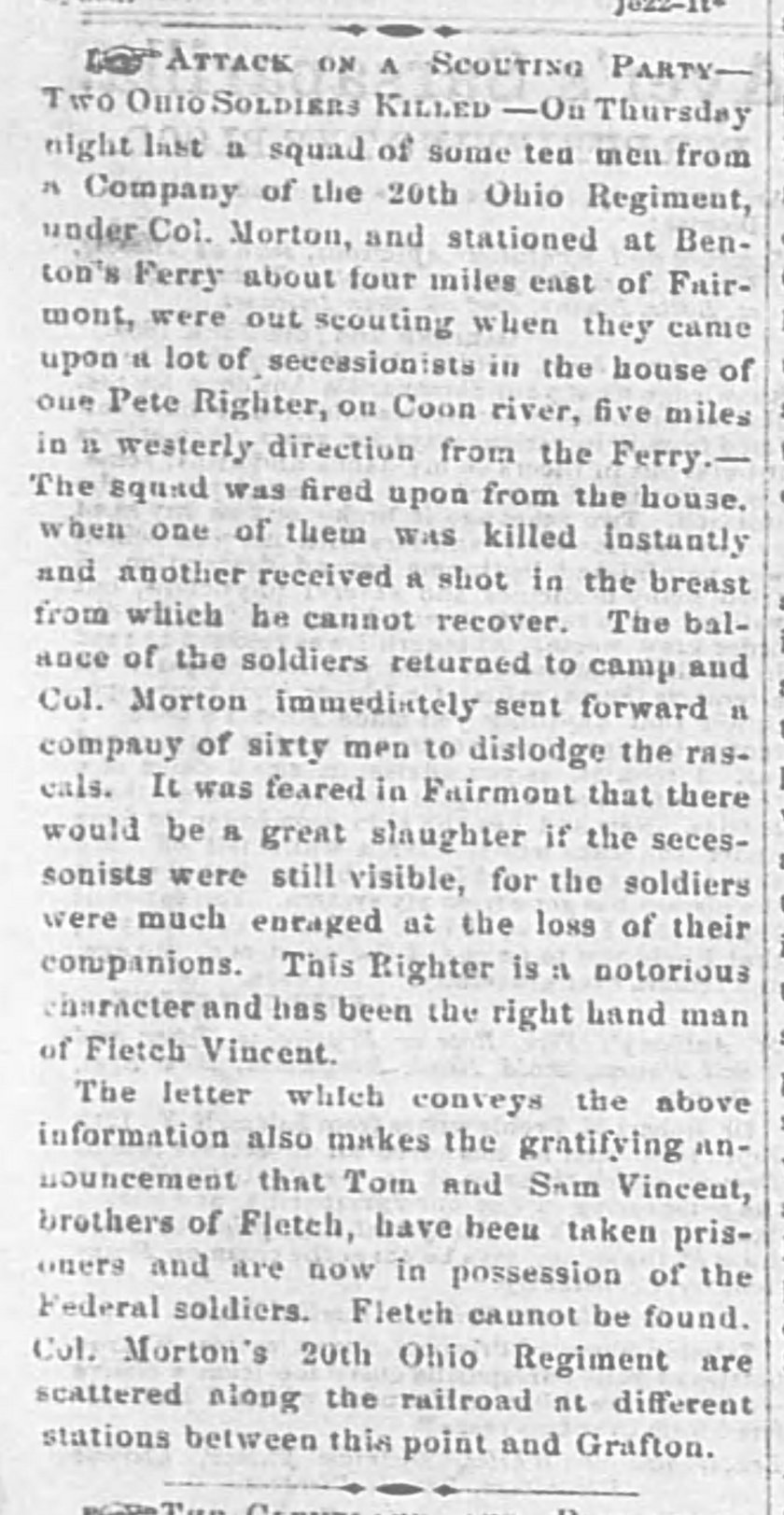
Daily Intelligencer (Wheeling, VA) 22 June 1861.
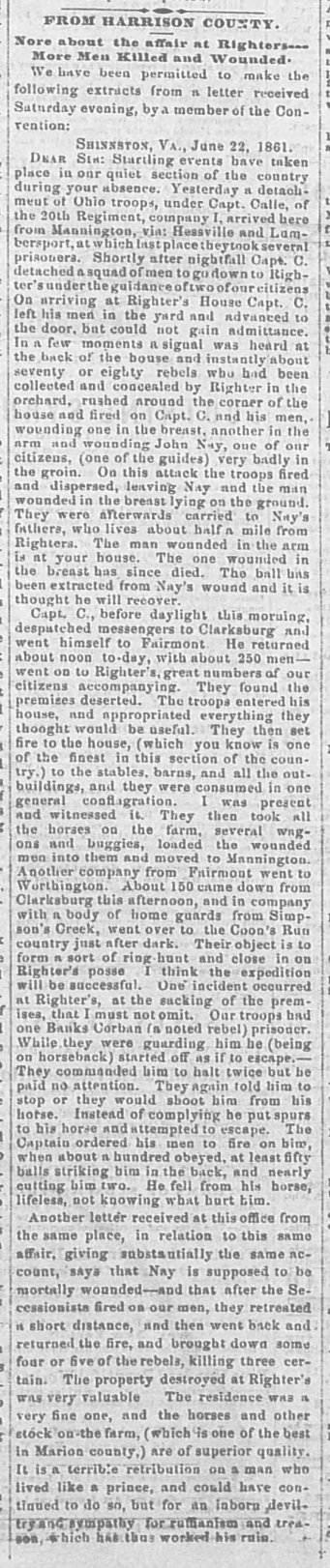
Daily Intelligencer (Wheeling, VA) 24 June 1861.
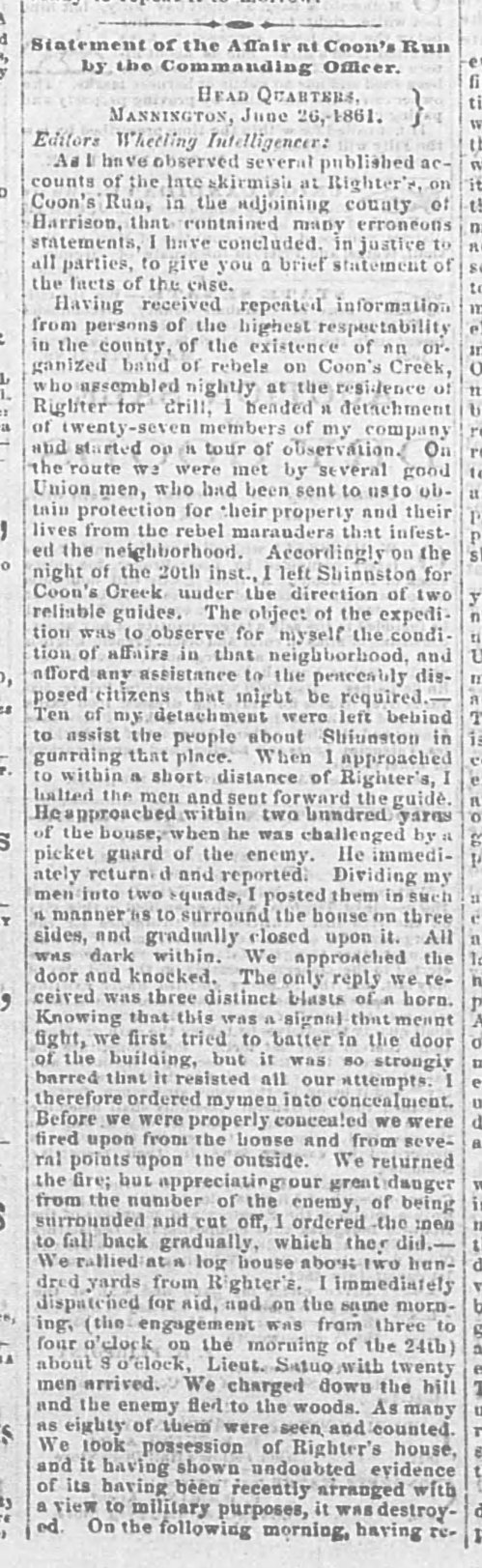
Daily Intelligencer (Wheeling, VA) 29 June 1861.
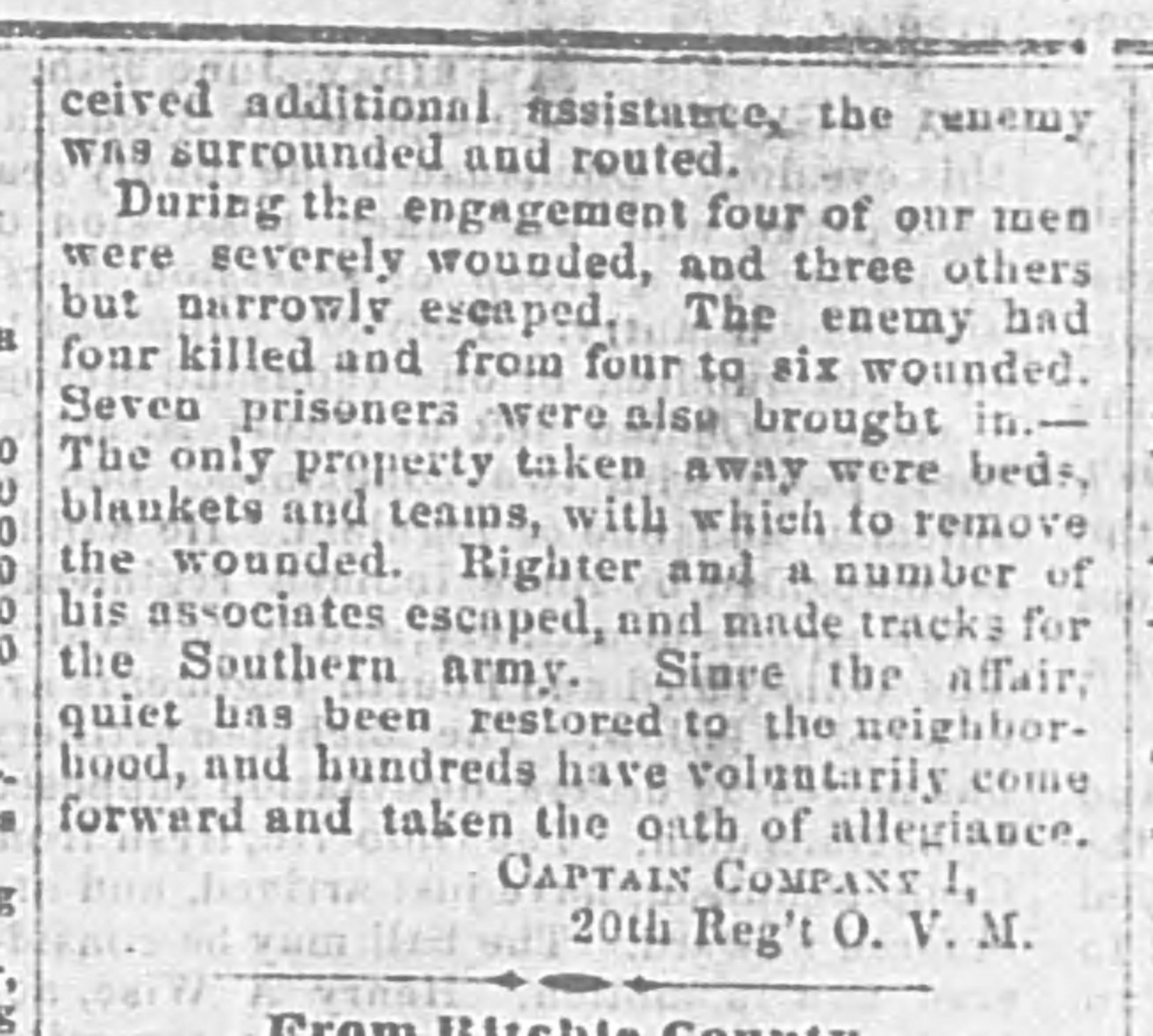
Daily Intelligencer (Wheeling, VA) 29 June 1861.
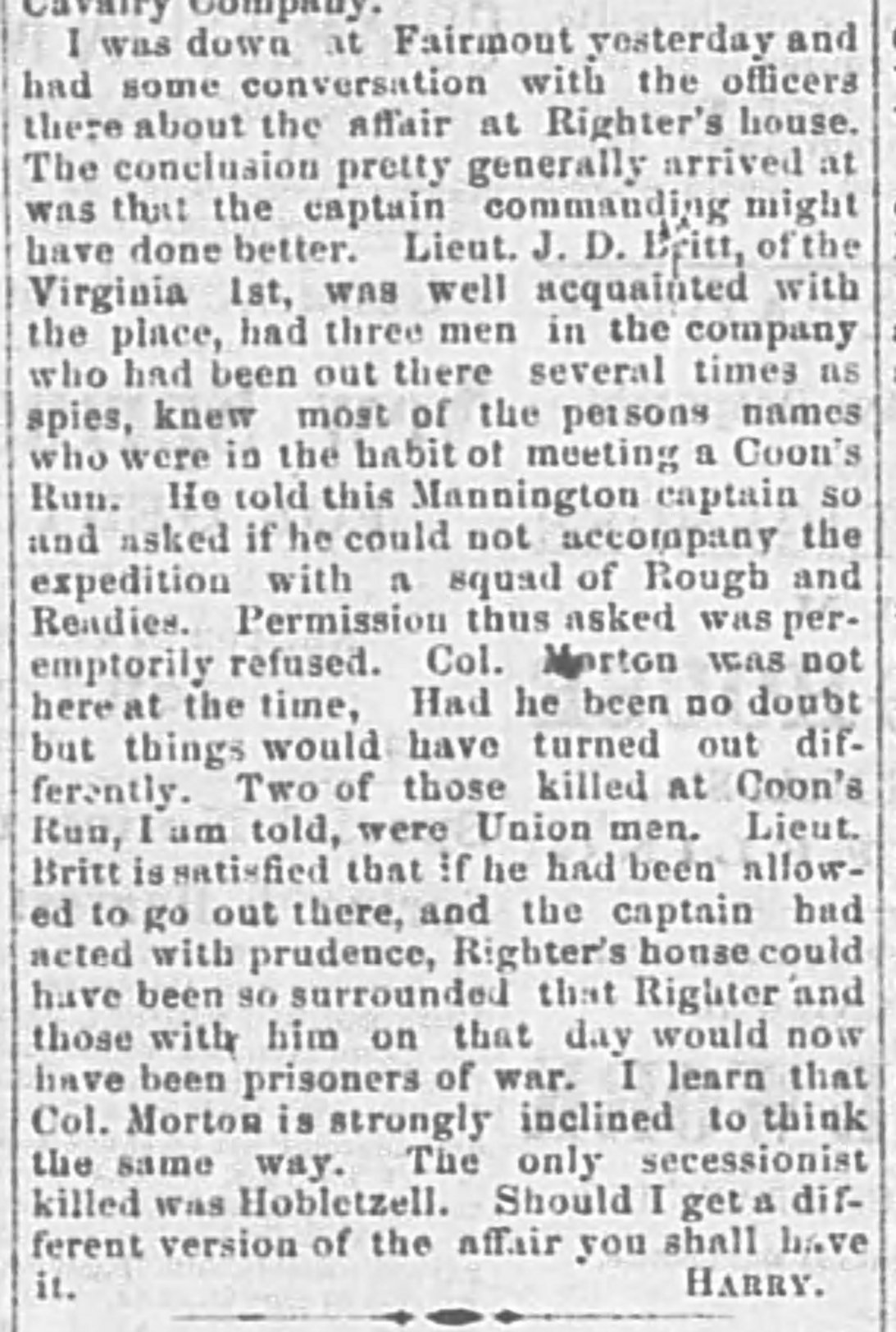
Daily Intelligencer (Wheeling, VA) 2 July 1861.

Weekly Herald (Steubenville, OH) 3 July 1861.
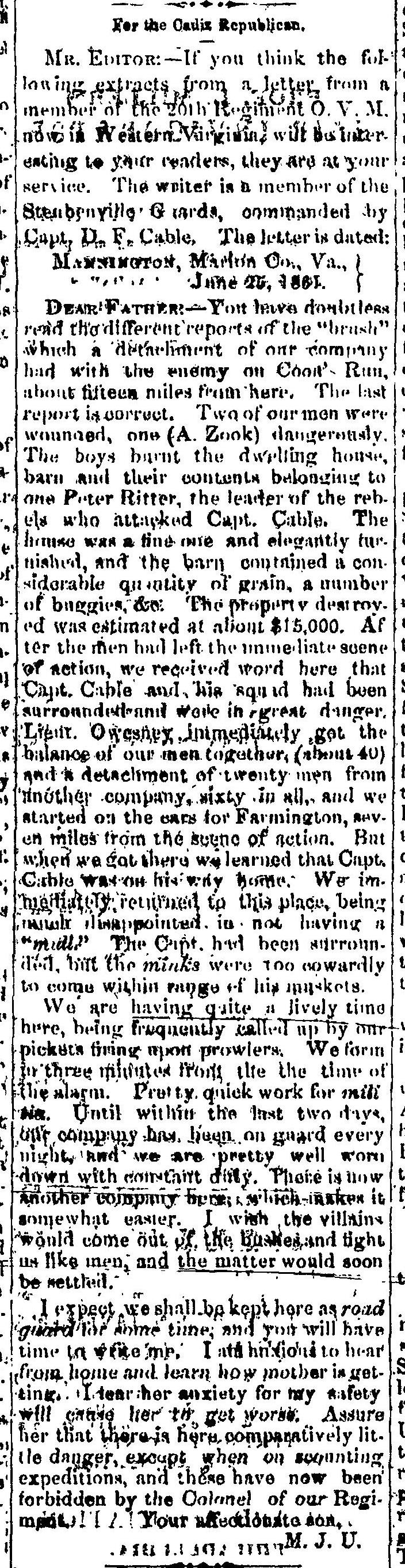
Cadiz Republican (Cadiz, OH) 3 July 1861.
For the Cadiz Republican –
Mr. Editor – If you think the following extracts from a letter from a member of the 20th Regiment O.V.M., now in Western Virginia, will be interesting to your readers, they are at your service. The writer is a member of the Steubenville Guards, commanded by Capt. D.F. Cable. The letter is dated:
Mannington, Marion Co., Va.,
June 26, 1861
Dear Father – You have doubtless read the different reports of the “brush” which a detachment of our company had with the enemy on Coon’s Run, about fifteen miles from here. The last report is correct. Two of our men were wounded, one (A. Zook) dangerously. The boys burnt the dwelling house, barn and their contents belonging to one Peter Ritter, the leader of the rebels who attacked Capt. Cable. The house was a fine one and elegantly furnished, and the barn contained a considerable quantity of grain, a number of buggies, etc. The property destroyed was estimated at about $15,000. After the men had left the immediate scene of action, we received word here that Capt. Cable and his squad had been surrounded and were in great danger. Lieut. O Wesney immediately got the balance of our men together (about 40) and a detachment of twenty men from another company, sixty in all, and we started on the cars for Farmington, several miles from the scene of action. But when we got there we learned that Capt. Cable was on his way home. We immediately returned to this place, being much disappointed in not having a “[illegible]”. The Capt. had been surrounded, but the minks were too cowardly to come within range of his muskets.
We are having quite a lively time here, being frequently called up by our pickets firing upon prowlers. We form in three minutes from the time of the alarm. Pretty quick work for militia. Until within the last two days our company has been on guard every night, and we are pretty well worn down with constant duty. There is now another company here which makes it somewhat easier. I wish the villains would come out of the bushes and fight us like men, and the matter would soon be settled.
I expect we shall be kept here as road guard for some time, and you will have time to write me. I am anxious to hear from home and learn how mother is getting. I fear her anxiety for my safety will cause her to get worse. Assure her that there is here comparatively little danger, except when on scouting expeditions, and these have now been forbidden by the colonel of our regiment.
Your affectionate son,
M.J.U.
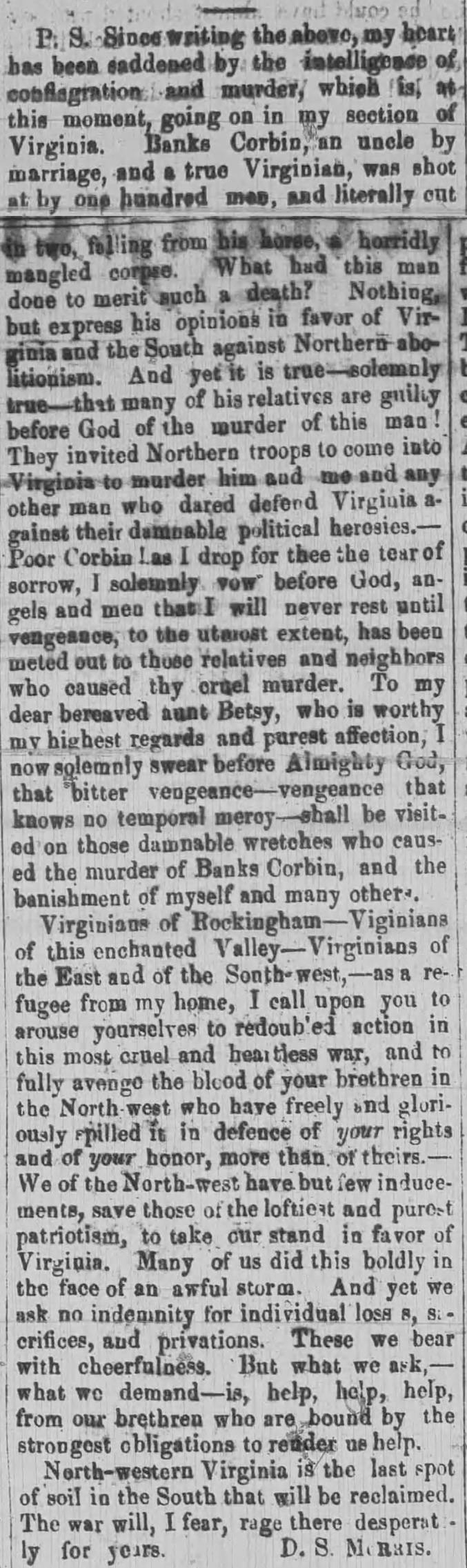
Rockingham Register and Advertiser (Harrisonburg, VA) 5 July 1861.
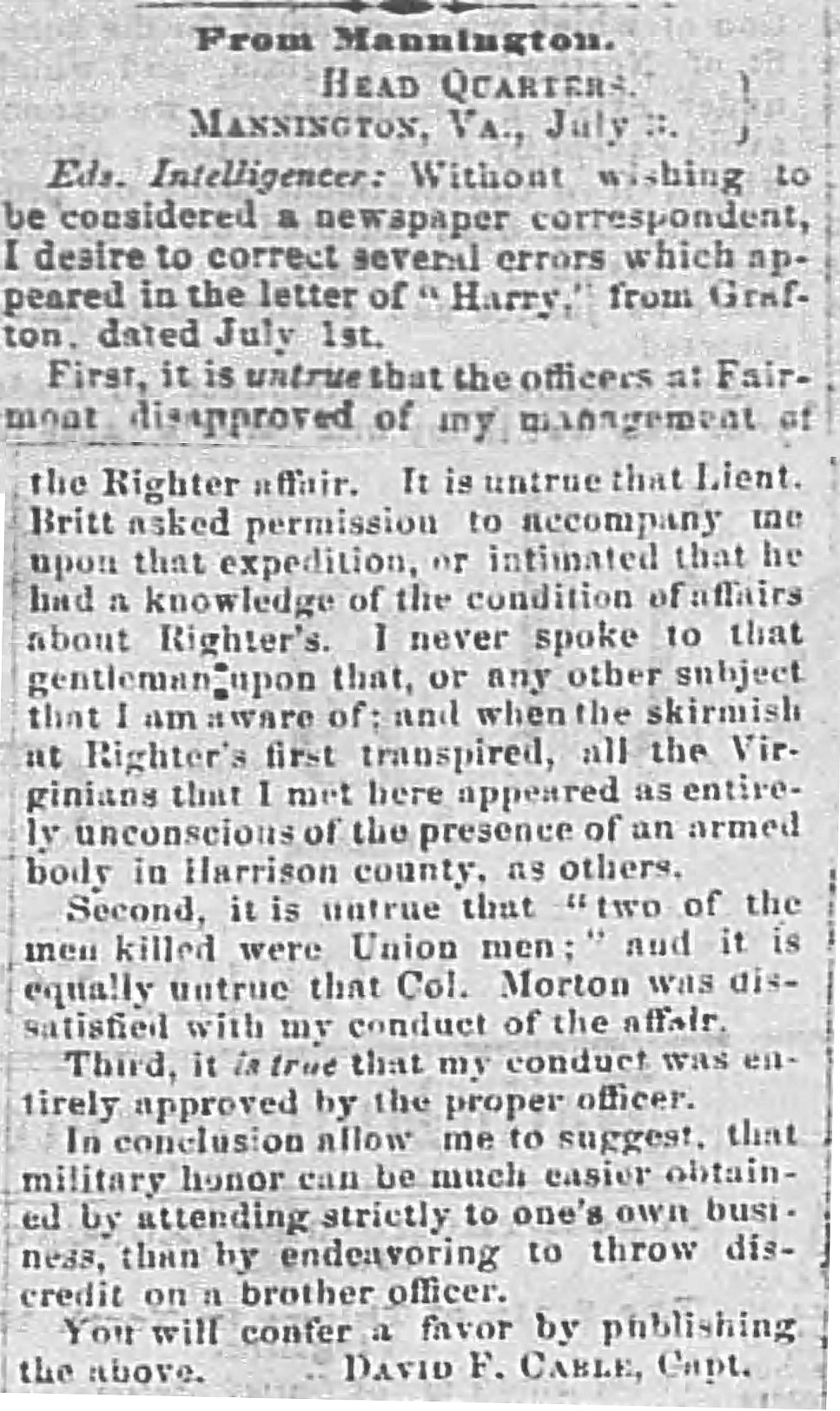
Daily Intelligencer (Wheeling, VA) 8 July 1861.
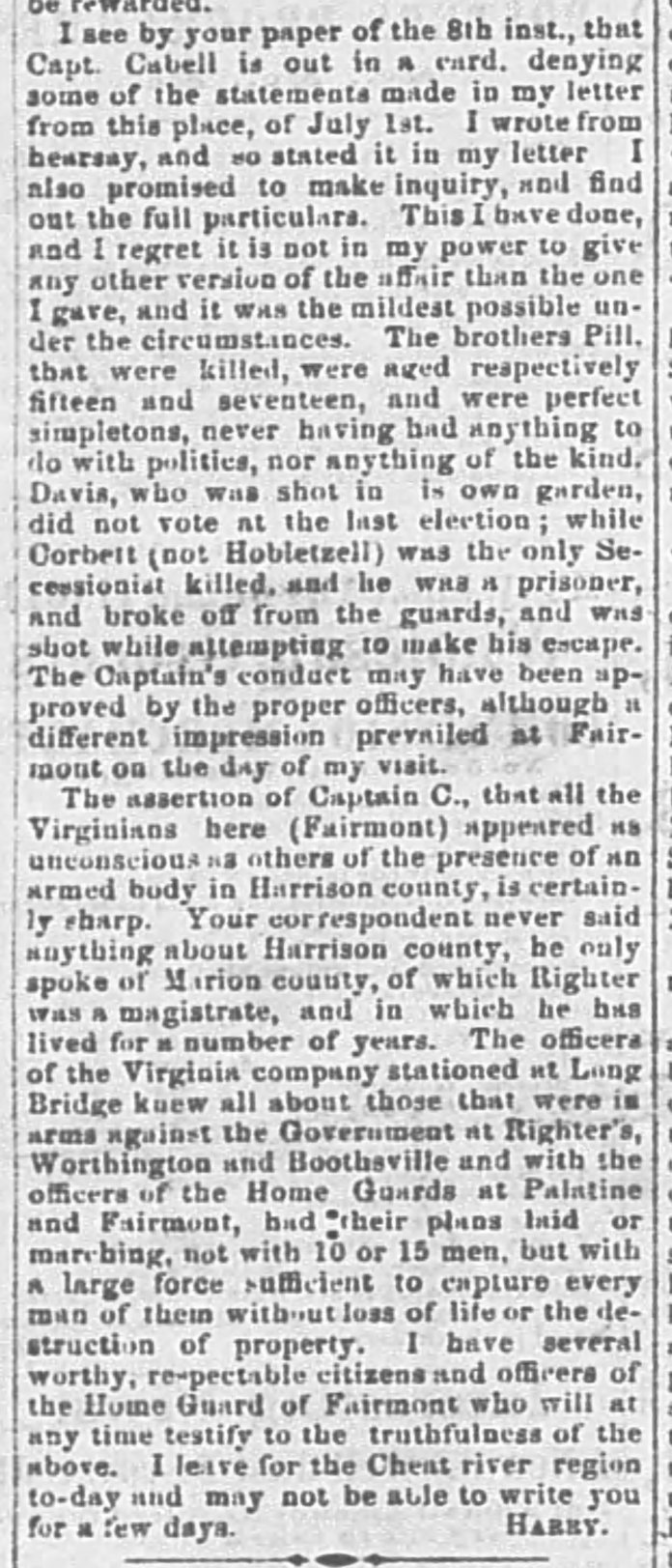
Daily Intelligencer (Wheeling, VA) 11 July 1861.
Reports and Letters
- June 19 Letter from Charles W. Russell to L. P. Walker
- Jun. 20 Telegram to Brig. Gen. Thomas A. Morris
- Jun. 22 Report of Maj. Gen. George B. McClellan
- June 22 Report of Col. Thomas Morton, 20th Ohio Infantry
- Jun. 23 Report of Maj. Gen. George B. McClellan
- Jun. 23 Proclamation to the People of Western Virginia
- Jun. 25 Address to the Soldiers of the Army of the West
Sources
Hall, Granville Davisson. The Rending of Virginia, A History. Chicago: Mayer & Miller, 1902.
Haymond, Henry. History of Harrison County, West Virginia. Morgantown: Acme Publishing Company, 1910.
Official Roster of the Soldiers of the State of Ohio in the War of the Rebellion, 1861-1866, Vol. 1. Akron: The Werner Company, 1893.
Osborne, Randall. Virginia State Rangers and State Line. Lynchburg: H.E. Howard, Inc., 1994.
Updated: 26 March 2026
Created: 23 March 2021
 Spirit of '61